

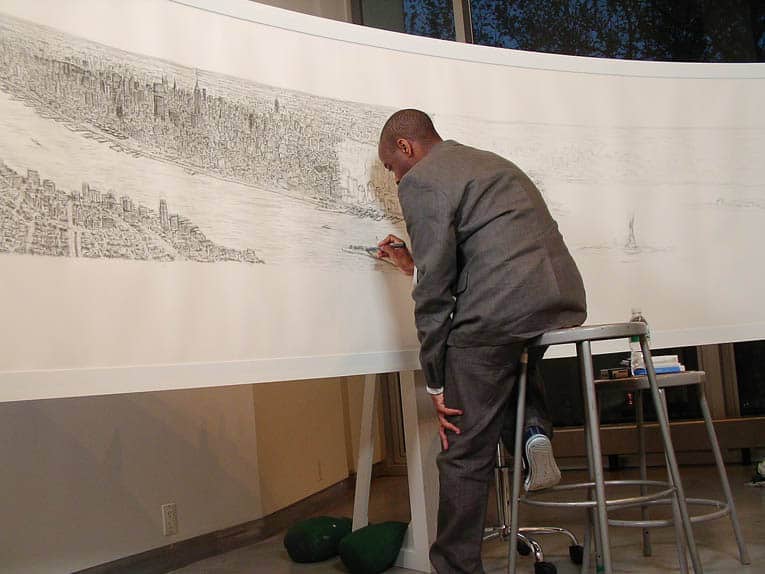
Anyone visiting the Empire State Building on 34th Street in midtown Manhattan is immediately drawn to its immensity. The Art Deco landmark became the iconic symbol of New York City since its completion in 1931. It is indeed a captivating site from near and far, from within and without. Over the years, numerous displays would be exhibited as part of its gallery on the second and 80th floors, paying homage to its timeless, structural beauty and the engineering success represented in its architectural design. Among the museum displays is a copy of a panoramic, hand-sketched, achromatic drawing of the New York City skyline, including the renowned 34th Street edifice. One of the things that makes the drawing a remarkable art piece–besides the incredible detail of the city-scape structures–is that it is an image that was committed to memory after a 20-minute helicopter tour of the Big Apple.
The architectural artist Stephen Wiltshire is credited with the drawing. He completed the panoramic sketch work of the city in five days, a remarkable feat for an artist who is well known for reproducing images of cityscapes from around the world strictly from memory. What also makes him intriguing is that he is on the autism spectrum. His admirable artistic talent and photographic memory have earned him respect from artists, architects, and laypersons alike. Incidentally, his drawing skills remind me of another gentleman on the autism spectrum with an uncanny ability to commit to memory visuals of buildings that fascinate him, sometimes inspiring him to take a pencil to the sketchpad or a paint brush to canvas. This gentleman is my younger brother, John.
I thought I’d share a bit about my experiences with my brother in honor of individuals on the autism spectrum. While Autism Awareness is on April 2nd, my recent holiday visit with my family to the Empire State Building (which is lit up in blue in honor of Autism Awareness Day in April) inspired me to make my story a holiday piece. And the fact that International Day of Persons with Disabilities is observed on December 3rd and recognizes and promotes the mission of the United Nations to protect the rights and dignity of people with disabilities to ensure their well-being and welfare in communities around the world makes the publication of this story in December equally fitting.
My Brother’s Admirable Talent
John’s drawings are typical of many individuals on the autism disorder spectrum in that he can reproduce an image from memory. Unlike Mr. Wiltshire, who beautifully captures an entire cityscape in one drawing, John creates drawings that are less involved and smaller in scale. Yet, his simpler recreation of structures vividly highlights their unique charm. He is particularly fascinated with residential buildings and trains in New York City and usually creates a painting or sketch that consists only of one or two structures. He has made several paintings and drawings of particular edifices and subway lines on elevated train tracks due to his captivation or familiarity with them.
One’s initial impression of some of John’s paintings and sketches may be that of rudimentary drawing. However, upon closer inspection, one will notice the detail given to an image that reveals his attention to the facade of the building or elevated train station. Details usually include capturing the outer architectural pattern, the hues and shades, and other features, such as the alignment of windows that anyone familiar with the actual structures would recognize upon seeing the reproduced images.
It’s astonishing and heartwarming to witness John become someone who expresses himself creatively. Equally stunning and heartwarming as well as enlightening is our shared early years.
An Astonishing Upbringing with a Brother with Autism
I am astonished at how my life with my younger brother has critically shaped my personal and vocational development. John is a great guy with a heart of gold. I recall constantly experiencing a special kindred connection to him because of his uniqueness. During my youth, however, living with him also involved an enduring thought of how others would view him and, in turn, view me and my family. There was a persistent awareness and, admittingly (in hindsight), periodic shame and embarrassment that I felt when it came to his presence in any setting outside the home. It was an awareness that often left me questioning if anyone taking notice upon their first encounter with my family of his interpersonal aloofness or awkward verbal response would ultimately feel differently about him and the family. On the flip side, any moment when his social interactions went no further than silently sitting still and, perhaps, being preoccupied with a toy or drawing for me resulted in a sigh of relief.
One reason for my periodic apprehension throughout my youth was that tantrums were a common, episodic occurrence throughout my brother’s childhood. For this reason, he received educational and social support services throughout his schooling. Anyone who did not understand the developmental challenges of someone with this condition would not have appreciated the importance of assimilating the behavioral vicissitudes of a person with autism and the critical need for educational and social support resources.
Outside of school and school-sponsored activities, efforts were made to include him in some recreational programs our oldest brother and I participated in, such as the Boy Scouts. These attempts proved to be precarious for the people who oversaw these programs despite their sincere efforts to include a child with autism. It was an era when many didn’t fully understand this pervasive developmental condition. And while research was just beginning to reveal a deeper understanding of the social and cognitive challenges of individuals on the autism spectrum, it would be a while before my family and I would better appreciate and better navigate his behavior in the home and the community. The two best experiences for him and our family were the psychologist who worked with him and our family as a whole and the psychiatrist who prescribed medication that significantly decreased his tantrums and helped him maintain a stable mood. Individual and family interventions eventually enabled us to understand the need for specialized resources for individuals like John to thrive into adulthood.
I eventually understood that many people overseeing youth recreational programs were unprepared to manage the challenges individuals like John faced with this condition. Fortunately, the public schools and the local community provided sufficient resources, including adequate social support and programs offering recreational outlets suited to his needs.
It has delighted me to see my younger brother make great strides with the help of outstanding teachers and compassionate healthcare providers. Observing the benefits of support services over the years, alongside my upbringing with him was quite enlightening. It gave me firsthand knowledge of the challenges faced by individuals who experience cognitive and social impairments and the stresses their families undergo from caring for these individuals. It helped me to realize the unique needs, attention, and reliable therapeutic structures that my brother and similar individuals require. This experience would ultimately lead me to pursue a career in psychosocial rehabilitation. (Presently, I oversee a state-funded, community-based program helping adults with special needs live independent and fulfilling lives.)
Today, John is an adult who attends a therapeutic work program in New York and enjoys drawing, listening to music, going to the beach, and eating lots of good food. Witnessing how therapeutic support services have benefited my brother and helped him grow as an individual has made me realize the importance of supporting research and organizations that work to increase our understanding of autism and improve the lives of individuals with this condition.
Help Advance Autism Awareness and the Vision of Having a “World Where all people with Autism Can Reach Their Full Potential”
My brother benefited from advocacy and research that delivered solutions that improved his quality of life. To help advance the work being done for individuals with autism, I’ve done the Walk for Autism Awareness several times. It’s a charity event organized by Autism Speaks and held in several cities and towns across the United States. These charity walks help further Autism Speaks’ mission to create “an inclusive world for all individuals with autism throughout their lifespan.” I encourage you to participate in a noteworthy cause by contributing to a charity, sponsoring a walker, or participating in a charity walk as a volunteer. It is this type of effort that will enable all of us to make a difference by advancing and accelerating autism awareness, autism research, and the autism support services that are informed by the science. It’s in keeping with the spirit of the holiday that we offer our generosity as an unconditional gift now and at any time during the year that could touch the lives of individuals who could benefit from the support.
I recommend visiting Autism Speaks and other similar sites to learn more about this condition and the efforts being made to improve the lives of individuals living with autism. I also recommend reading about Stephen Wiltshire and his fascinating contributions to the art world.
I wish you all hope, faith, joy, peace, and good health this holiday season and in the new year. Happy holidays!
Pedro Antonio
© 2024 The Health-promoting Bandwagon. All rights reserved.
Editor’s Note: This story was updated to include additional information about my brother for clarity and a photo reflecting Stephen Wiltshire at work.
 The Health-Promoting Bandwagon